Advent of the Underbar
Advent of the Underbar
According to podcast index, there are (at the time of writing) 4,558,912 podcasts, 432,264 of which have been published in the last 60 days.
The Underbar is one of them.
That is a lot of podcasts, and the first question that comes to mind is "why create another one?" (quickly followed by "how long do you think it's going to last?").
A tangent: my pandemic projects
Before I can describe the podcast, I have to go on a tangent, which will set the stage for how I ended up creating yet another computing podcast.
During the 2020 pandemic (I sadly think we'll have to date them), and more specifically during the global lockdown, a lot of people were telling the world how they spent their newly discovered free time baking bread or exploring their artistic side.
Having worked mostly remotely for over a decade at the time (my team was in Amsterdam, Netherlands, and I worked from the local office in Lyon, France), I didn't feel much change (except that my office was now in my home).
I too wanted to have lockdown projects, so I came up with three. My hope was to complete at least one of them in a reasonable amount of time (before the end of 2021, I think).
🗹 Le bâton de joie
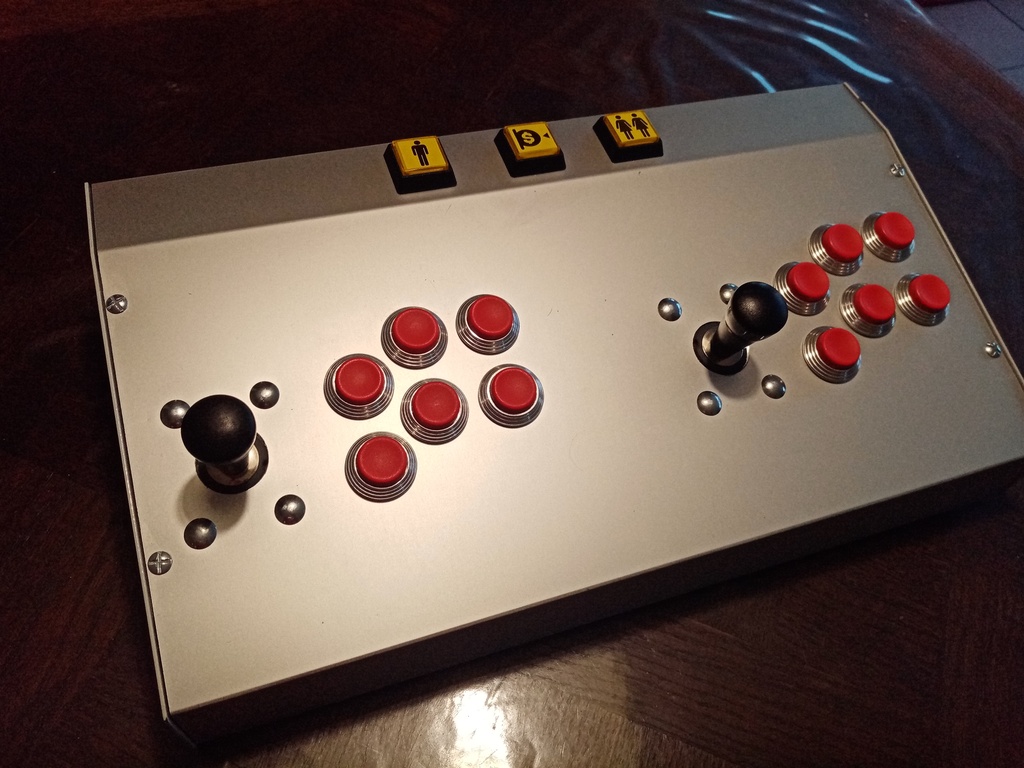
My first idea was to pick up and finally finish a 20 years old project: building an arcade joystick to play arcade games on an emulator (such as MAME).
That project was started with two friends in 2000. Back then, we had bought all buttons and sticks from an arcade repair shop, pulled the electronics out of a PS/2 IBM Model M keyboard, mapped the keys to the pins, and wired one joystick and two buttons. The whole lot went into a box after we plugged it into a computer and we managed to play a game of Frogger with it.
Another reason for putting on hold is that one of the friends' wife cheated with the other, forgetting the first rule of gaming: don't cheat with friends. Over the course of 20 years, another friend gifted me a chassis, that sat alongside the box for over a decade.
Picking up that project after 20 years, everything was easier. Now I could buy USB zero delay joystick adapters on the Internet, and throw away the keyboard electronics. I just had to drill 17 or so holes in the chassis, screw in all the buttons and joysticks, and wire the lot to the USB cards. After attaching a Raspberry Pi to the side (another thing that didn't exist in 2000), I could temporarily move the Nintendo Switch away, and show my kids what videogames looked like in the eighties.
This took a few months to complete in real time. We played our first games in May 2021.
🗷 Programming Sentimental Advice Column
My second project I dubbed the "Perl Love Letters". The idea was to set up a web site to collect and publish "love letters" (and possibly breakup letters too), written to Perl by its users or ex-users as if it were an old flame.
I've been part of the Perl community since 1999, and I've had numerous conversations with lots of people about Perl, what we love about it, its quirks and its future. I really believe there is a trove of interesting stories of people discovering Perl, some sticking with it, some moving on, etc. We collectively have a lot to say about this programming language, and how it changed our lives.
This idea was inspired in particular with a late night bar conversation with my then work and later Perl Steering Council team mate Graham Knop, who told me sincerely, almost within the same breath, that Perl was the worst programming language, and also his favorite one.
Alas, although I thought about it many times, I never managed to write my own love letter to Perl. This project remains a cute idea to this day.
(As the quote goes, "ideas are easy": if you're interested in making this happen, please do. I promise I'll write my love letter to Perl and send it to you once you have set up the web site.)
☐ The book that did not exist
As I considered the shelves in my office, filled with computer books, from those I have barely skimmed to those I read from cover to cover, I realized that there was one book that I wanted to read. The main problem was that no-one had written it.
I wanted to read a Larry Wall biography.
Instead of badly rephrasing it, I'll quote the email I sent Gloria Wall in 2023 (!), to present the project:
In late 2020, at the height of the pandemic, I looked at my computer books collection, and realized there was one book that was missing in there. One book that I would really really love to read. A book that would not be afraid of technical jargon, or showing some source code or raw emails: a book written for people like me. A book that details the enormous influence Larry Wall has had on Open Source and programming in general.
It turned out no one had written that book yet.
For the past two years, my fantasy project has been to collect material for whomever would write that book. I'm not an author, I'm not even a native English speaker, so I knew from the beginning the author couldn't be me. A year ago, I was chatting with my good friend Wendy van Dijk, and I exposed the project to her in more detail than I had ever written before:
I want to know about
patch, aboutrn. About howpackandunpackcame to be. Sure, some of the personal details too, but his philosophy of computing and collaboration is more interesting.Also, biography is a specific kind of book. We'd need someone who knows how to write one, and an editor, etc.
There's also the story of the early days of Open Source. Wasn't he in the meeting where the name "open source" was coined?
He's been both influential and humble.
I also feel I can't be the one doing it. Maybe ask some questions, run some interviews, but one has to be a native speaker, and a writer, and I'm neither.
[...]
At the last Perl Toolchain Summit, which I organised in my home city of Lyon, France, I talked about this with Ingy döt Net and Leon Timmermans. They both thought this was a great idea, and someone should definitely do it.
[...]
I don't know if this project will actually lead anywhere. Best case, an actual book will exist in a few years. Worst case, some material will be available for someone better equipped than me to pick this project up.
Gloria's reply is a wonderful example of her wit and Larry's humility:
Personally I don't think Larry's life is all that compelling--he has spent most of it typing on a computer keyboard or in long bouts of just thinking (while staring at a computer screen). But yeah, he changed the world.
The story of Larry Wall is intertwined with the story of Perl and the early Internet (between the Unix wars and the Dot-com bubble burst).
The way I saw this biographical project involved a data collection step: find and save as much of what was already available (interviews, videos, etc). Another side of it was producing more data: get Larry's answers to the specific questions I had, and get the people around him to talk.
The project is currently in a limbo state: I have collected some material, but Larry is mostly retired, and doesn't seem very interested in talking about all this. I eventually lost steam, and moved to other things.
Why create another podcast?
Back to the podcast and why I created it.
I slowly made my way into recording a podcast by listening to a few of them.
In 2021, my colleague Bailey Stewart suggested to me the On the Metal podcast. After listening to all episodes (and waiting for the next one for a very long time, not realizing they had moved on to another format), I started listening to Digital Citizen, by our very own Ricardo Signes.
It was Ricardo who suggested to me in January 2024:
Advent of Computing is excellent, and I think you'd really like it.
He was right on both counts: Advent of Computing is excellent, and I really like it.
The history of computing and programming is one of my favorite topics (my shelves contain both books about the history of computing, and historical computing books).
The unwritten book project, combined with my recent interest in computing podcasts, planted the idea of making my own podcast in my head. Telling the story of Larry Wall's enormous influence on modern computing is a herculean task, probably beyond my reach, but that wouldn't prevent me from trying to record some fireside stories of the Perl community.
A little bit over a year ago, as I was trying to write my Advent Calendar entry for 2024, I started talking with Olaf Alders about the idea that had taken root in my head:
I'm listening to podcasts, and there's one I'm slowly getting into https://oxide.computer/podcasts/oxide-and-friends It feels like being in a bar conversation with other technical people. I don't always fully understand what they're talking about, but I like what I hear.
I'm been thinking about having something like this with people I know for some time, thinking about doing it at work (but being worried that the suits would not like the idea of a recording, and that maybe the participants wouldn't like it too much either). I already do "old men ranting calls" with colleagues, but we haven't recorded them so far. Would probably be too controversial anyway...
Now I'm wondering if an idea like that could work with Perl people. We're used to hanging out in bars, after all! What do you think?
To which Olaf replied:
I think it would be an interesting experiment. I have fond memories of Perlcast: <https://perlcast.net/>
I believe Olaf's superpower is to encourage people to actually do what they already wanted to do in the first place, and just jump in.
JFDI in action
This was also an experiment in getting things done in spite of my perfectionist mindset. Better make something now and improve it over time, than plan for the perfect outcome and never achieve anything. (As noted earlier, ideas are easy. The real effort is in delivering on those ideas.)
Over the years, I've tried to think less and do more, because I also know that (according to The Cult of Done Manifesto), "Done is the engine of more". And I want to have produced more than just ideas with my time in this world.
Anyway, at the end of December 2024, we picked the topic du jour (the new Perl logo), grabbed everyone who was involved, and eventually recorded our conversation. Thibault Duponchelle helped with editing this first episode (which was numbered 0, obviously), while I slapped the new Perl logo on the podcast logo (I've been having a lot of fun creating the logos for the individual episodes!) and created a static web site to host the feed. In our excitement, we went from recording to publication in little more than a week!
I managed to convince Olaf to be my co-host: I think we complement each other well, and that widens the scope of questions we ask to our guests.
Podcasting as data collection
My goal is not just to record those interesting conversations with the people who make things happen. Using modern technology, it's very easy to have good enough transcripts. Apple Podcasts generates one automatically after publication, and when using Zoom (thanks to The Perl and Raku Foundation for letting us use their license to record some of our episodes), we have a transcript along the raw recording.
My plan is not only to edit and add those as closed captions for the podcast, but also put them on the web site, for better searchability and indexing. Adding notes for the readers is also a goal. This would let us explain the jargon, and point to more sources for those who want to dig in.
I want to record witness accounts, from primary sources, of what the Perl and Open Source communities have achieved over the years.
How long will this last?
I didn't want to fall into the classic blunder of buying new gear for a new project, and then leaving it gathering dust on a shelf because the project went nowhere. So I promised myself I'd only get a proper microphone when I have published enough episodes with a regular schedule. My self-imposed target was the end of the year and the holiday season. By then, we'll have published 9 episodes, and I expect to find a nice microphone under the tree this year. (Here is your connection to Santa Claus for this Advent Calendar entry!)
Hopefully, as long as there are people interested in talking about past, present and future Perl, we'll be able to get them to talk to us. I've set my sights on a relaxed schedule (one episode a month), which doesn't put me under too much pressure. I'm also not doing this alone: Olaf Alders is co-hosting the podcast with me, Salve Nielsen is bringing his ideas and contact list to the talk, and Thibault Duponchelle is regularly reminding me of my responsibilities as a publisher. Dave Cross made one of the first pull requests, to add a prominent link to the podcast feed on every page of the web site. And of course, over 20 people have been talking with us on the podcast!
I've paced myself, because I'm in this for the long run. One episode a month seem about right as a schedule. I want to have more of those conversations, I want to hear the story of Perl and its communities, and more generally, of Open Source and Unix communities and projects.
We haven't run out of topics yet.
The first year
After the first episode, we just ran from there: at the end of February we had recorded another episode, on a more controversial topic (Perl 42).
It took more time than expected to get it published (May), but we respected the self-imposed schedule of one episode a month since (the August episode was delayed until September; since there was also a September episode, so I count this as within the margin of error).
Here's a summary of our published episodes:
Episode 0 - The New Perl Logo
Episode 1 and 2 - Perl leadership and Perl 42
During the Perl Toolchain Summit 2025 in Leipzig, Salve J. Nilsen lended his recording material, and we spent the entire Sunday recording conversations with teams assembled there. This led to four more episodes:
Episode 3 - MetaCPAN
Episode 5 - Test::Smoke
Episode 6 - CPAN Testers
Episode 7 - CPAN Security Group
During PTS, I also spent some time talking with Salve about the upcoming European CRA law, and we thought it would be useful to record a version of that conversation for a larger audience:
Episode 4 - The Cyber Resilience Act
Salve has a lot of contacts in the Open Source community, and he managed to get a slot on Olaf Kolkman's busy schedule. We recorded a three hour conversation with the pioneer of DNSSEC and prominent Internet Society member Olaf Kolkman, which will make up our next two episodes.
Help needed
The podcast format captures the conversations, and makes it easy to enjoy those conversations while doing something else (I do most of my own podcast listening while walking outside or cooking). But if this material is meant to be used as "primary source" for some future work about the history of Perl and its community, text is going to be the best format long term.
If there are topics you want to listen to, or corrections you want to make to the web site, you can write to underbar AT cpan.io or submit a pull request to the repository
Can't wait to hear from you!
 This article contributed by: Philippe Bruhat (BooK) <book@cpan.org>