The Night Before Deployment: How Melian Saved Christmas (and How It Can Speed Up Your App Too)
    It was the night before deployment,
    and all through the North Pole,
    not a dashboard was green,
    not a query was whole.
December 23rd is the annual Mega Load Test for the Christmas Eve delivery system. Every service (the Toy Inventory API, the Naughty-or-Nice Scoring Engine, the Elf Logistics Portal) suddenly wakes up to millions of requests. And every year, something new falls over.
This year, it was the Toy Service.
At 16:04, an alert fired:
"Average latency > 2000ms on SELECT toy WHERE id=...."At 16:05, another:
"Database CPU 100%. Replica lag increasing. Costs spiking."By 16:06:
"SLEIGH ETA CANNOT BE COMPUTED. CHRISTMAS IN JEOPARDY."Elves ran around in chaos. Santa sipped his cocoa with growing concern. Someone suggested buying a larger RDS instance until after Christmas, but the last time they did so, Finance needed six months to recover.
🎁 "Why are these SELECTs so slow?" cried an elf.
The Senior SRE Elf adjusted his tiny glasses. "SELECTs aren't slow," he explained. "We just run too many of them. Thousands per second. Most ask for data that hasn't changed in weeks. The database is spending all its time doing unnecessary work. We're melting our own servers!"
Another elf waved a stack of sticky notes. "I told you we should cache it inside the Toy Service! Just store the toys hash in memory!"
The SRE Elf shook his head. "We tried that last year. Remember the disaster? Every app instance kept its own copy, different instances refreshed at different times, some toy names were up-to-date, others were from 2018, every instance restart dogpiled the DB, deployments caused mass reload storms, memory bloat everywhere, and no central control."
"We can't fix a distributed caching problem by scattering more distributed caches across the fleet," he said gently. The Elf in Charge of Sticky Notes began quietly eating his notes in shame.
Another elf jumped in. "We could use Redis! At least that's centralized."
"Better," said the SRE Elf, "but Redis still puts pressure on our infra. And storing ten or twenty entire tables that elves query thousands of times per second? We'll need a large Redis cluster, which means larger AWS bills, and not the fun kind with reindeer on them."
The room fell silent. Santa tapped his mug. "We need something faster," he rumbled, "and something cheaper."
🎄 The Ancient Scroll
At this, the Senior SRE Elf's face lit up. "There is something... something old. Something powerful."
He ran to the dusty archives and dragged out an ancient scroll titled: "MELIAN: Keeper of Rapid Knowledge, Maia of Snapshots and Speed." .
He unrolled it.
"It's a tiny server that loads whole or partial tables into memory," he explained. "It refreshes them in the background, using a snapshot model - zero locking, no race conditions. It serves lookups in microseconds. We offload millions of SELECTs from our database. Capacity costs drop instantly."
The elves gasped. "Does it work with our stack?"
"It speaks a simple protocol and already has clients in C, Perl, Python, PHP, and Node.js. Even better - Melian is already on CPAN!"
One elf whispered: "Faster than Redis... cheaper than scaling up the DB... and simpler than fixing our app caching disaster... Santa, this could work!"
Santa smiled. "Then bring forth this Melian. Christmas depends on it."
✨ Deployment at the North Pole
They configured Melian with a few environment variables:
Which database to load from (MySQL/Postgres/SQLite)
Which tables, which indexes to search on
How often to refresh the tables
And then, on a snowy December evening, they launched it.
Immediately, Toy Service queries went from:
400 milliseconds → around 10 microseconds
Database CPU dropped like a sleigh down a steep hill
AWS costs flattened
Replica lag disappeared
Dashboards turned green once again
Santa clapped. "We've saved Christmas AND our budget!"
But the Senior SRE Elf wasn't done. He added one more twist.
"Since Melian can serve derived tables, we don't have to reshape the database. For example, instead of querying toys_by_id, we can create a computed view toys_by_person_id or any other ephemeral materialization. Melian doesn't care whether the table exists physically. It just stores the results of whatever SELECT we give it."
Suddenly, the elves realized the power they held. "This is... this is beautiful," whispered the Sticky-Note Elf.
🎁 And Now: How You Can Use Melian
While the elves used Melian to rescue Christmas, you don't need a sleigh-scale workload to benefit from it.
Maybe you have:
A personal dashboard
A local inventory
A home-lab metadata list
A script that needs lightning-fast lookups
A SQLite file you query too often
Let's walk through a simple real-world setup you can use today. And with this knowledge, you might be able to use Melian at work tomorrow.
For this example, we'll build a small Gift Tracker backed by SQLite.
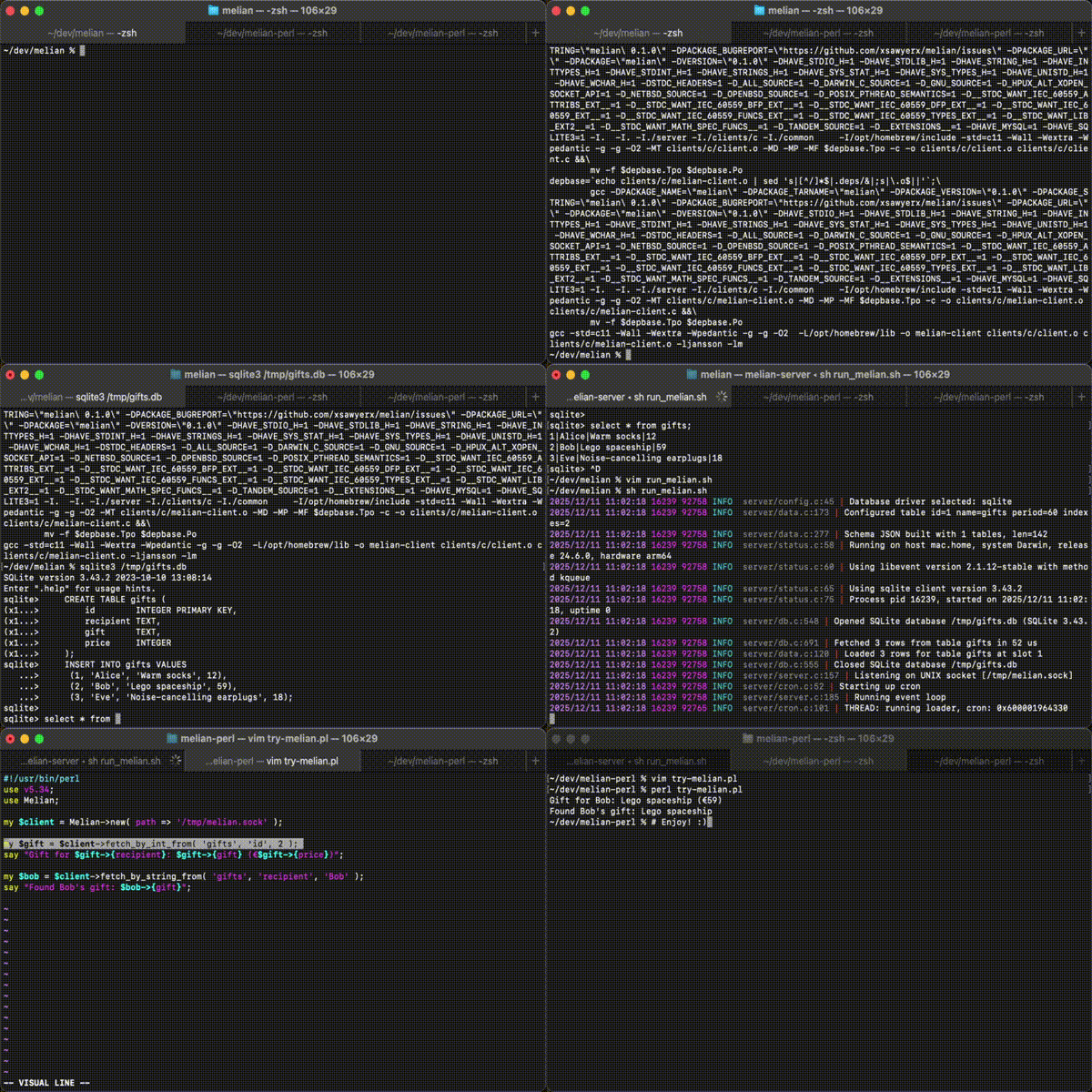
🎄 Step 1: Create a Tiny SQLite Database
CREATE TABLE gifts (
    id        INTEGER PRIMARY KEY,
    recipient TEXT,
    gift      TEXT,
    price     INTEGER
);

INSERT INTO gifts VALUES
 (1, 'Alice', 'Warm socks', 12),
 (2, 'Bob', 'Lego spaceship', 59),
 (3, 'Eve', 'Noise-cancelling earplugs', 18);
Save it as: /tmp/gifts.db, though a more production-friendly location would be /var/db/melian/gifts.db or using MySQL/MariaDB/PostgreSQL.
🎄 Step 2: Configure Melian
Instead of a config file, we will use environment variables:
# What backend we use? sqlite/mysql/postgresql
export MELIAN_DB_DRIVER=sqlite

# Where is the SQLite DB file located?
export MELIAN_SQLITE_FILENAME=/tmp/gifts.db

# Define a single table with two indexes:
export MELIAN_TABLE_TABLES="gifts#1|60|id#0:int;recipient#1:string"
The MELIAN_TABLE_TABLES means:
The table is named
giftsIt's identified with the ID
1(we could pick any number)It refreshes every 60 seconds
It has two indexes:
id(integer type for integer lookup)recipient(string type for string lookup)
🎄 Step 3: Start Melian
melian-serverBy default, it listens on the UNIX socket /tmp/melian.sock.
You can configure it to use a hostname and port, but a UNIX socket is the fastest by far.
🎄 Step 4: Query Melian from Perl
(Yes, the elves use Perl too - it's very popular north of 89° latitude.)
use v5.34;
use Melian;

my $client = Melian->new( path => '/tmp/melian.sock' );

# Fetch by numeric key: table 'gifts', column 'id', key '2'
my $gift = $client->fetch_by_int_from( 'gifts', 'id', 2 );
say "Gift for $gift->{recipient}: $gift->{gift} (â~B¬$gift->{price})";

# Fetch by string key: table 'gifts', column 'recipient', key 'Bob'
my $bob = $client->fetch_by_string_from( 'gifts', 'recipient', 'Bob' );
say "Found Bob's gift: $bob->{gift}";
And the result:
    Gift for Bob: Lego spaceship (€59)
    Found Bob's gift: Lego spaceship
These lookups usually complete in single-digit microseconds.
There are additional ways to use Melian that make it faster and faster:
Storing the IDs of the tables and columns to avoid Melian having to resolve them.
Using the functional interface, cutting down the cost of object-oriented in Perl.
🎄 Bonus: Ephemeral Derived Tables
Remember how the elves created a temporary table like toys_by_person_id?
You can do that too:
export MELIAN_TABLE_SELECTS="gifts=SELECT person_id, gift FROM gifts JOIN persons USING (id)"Melian doesn't require the table to exist physically — it just needs a SELECT that returns rows.
This lets you use Melian as a lightweight materialization layer without touching your source schema.
☕ Wrapping Up (with Cocoa)
That night, as the Toy Service hummed at 95,000 requests per second and the database rested peacefully for the first time in years, Santa lifted his mug and declared:
    "Let this be a lesson to all of us:
    Sometimes the fastest way to scale a system is to stop asking the database unnecessary questions."
Melian didn't just save Christmas. It saved capacity, money, performance, and developer sanity.
And who knows? Maybe it can do the same for your next project, festive or not.
Happy Holidays, and happy hacking! 🎅✨
References
 This article contributed by: Sawyer X <xsawyerx@cpan.org>