The Ghost of Perl Developer Surveys Past, Present, and Future
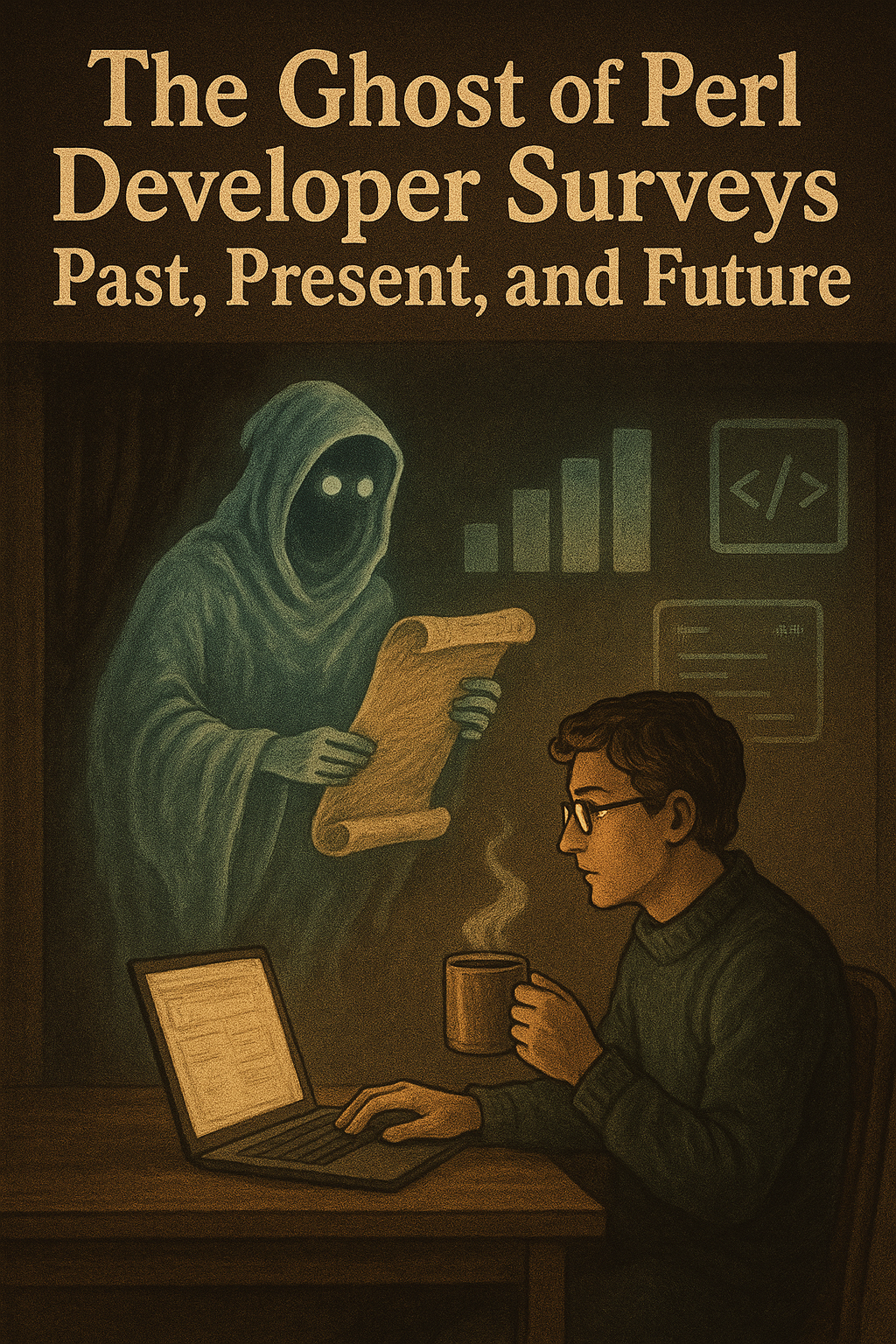
It was a quiet December evening when a weary Perl developer—curled up with a warm mug of cocoa—received an unexpected visitor. The logs rustled. The LEDs flickered. And from the shimmering depths of CPAN emerged a familiar yet mysterious figure: The Ghost of Perl Surveys Past.
"Come," said the Ghost. "It is time to see what the community has been building, breaking, and dreaming over the years."
And so began our spectral journey through the Perl Developer Survey, culminating in the 2025 edition—our newest glimpse into the life of the language and the tools that help keep it alive.
The Ghost of Surveys Past
The Ghost whisked our developer back to the origins of Perl community surveying, when the questions were simpler, the spreadsheets smaller, and the editors... surprisingly similar.
The early surveys of 2009–2010 didn't try to capture the entire ecosystem; they focused on the fundamentals of how Perl developers worked, what shaped their decisions, and what tools they trusted.
The Ghost unfurled four parchment scrolls from those early years.
October 2009 — Which editor(s) or IDE(s) are you using for Perl development?
Vim and Emacs reigned like ancient kings, their terminal thrones rarely contested. Padre was young and promising. Komodo IDE had loyal supporters. Notepad++ and TextMate rounded out the tribe of early Perl scribes.
Modern Perl tooling builds on this foundation, but the Ghost smiled knowingly: Vim and Emacs are still with us. Some ghosts never leave.
November 2009 — What other technologies, languages, templating systems are you using besides Perl?
Early surveys discovered that Perl developers were well versed in the web ecosystem, often using JavaScript, HTML, CSS, SQL, and XML alongside Perl.
This was a hint that Perl developers were not isolated in their own world, but active participants in the broader web development community.
April 2010 — What is the primary operating system you use for developing Perl applications?
Linux dominated. macOS was rising among laptop-toting developers. Windows was present but rarely central.
The picture painted was unmistakable:
Perl grew up in UNIX-like environments—and thrives there still.
May 2010 — What are the most important features of an employer or a job opportunity for you?
Even in 2010, developers asked for:
good compensation
interesting technical challenges
stability
respect for work-life balance
opportunities to use modern Perl practices and tools
respect for Perl as a language
"These questions were seeds," the Ghost said. "From them grew the surveys we know today."
The Ghost of Survey Present (2025)
The Ghost shimmered and shifted, becoming a modern figure surrounded by bar charts, editor icons, CI pipelines, and version numbers. It held up a scroll containing the freshly gathered results of the 2025 Perl Developer Survey.
"What do Perl developers look like today?" the Ghost asked.
The 2025 survey revealed a vibrant, diverse conglomeration of developers, using a variety of tools. The ghost's scroll contained an iframe embedding the full results:
https://survey.perlide.org/results/2025
Some highlights included:
Editors and IDEs: Vim led the pack, with Visual Studio Code taking a large share, and Emacs trailing behind.
Other Tools: Perl::Tidy was used by the majority of respondents.
Language Version: Perl 5.40 was the most commonly used version, with a significant number also using Perl 5.42 and 5.38.
CPAN Client: cpanm was the dominant CPAN client, with cpan and other clients also in use.
The Ghost of Surveys Yet to Come
A silent figure emerged—hooded and watchful: The Ghost of Surveys Yet to Come, revealing only outlines and possibilities.
The ghost spoke in riddles:
"What if we could peer into the future of Perl development? What trends might we see? What tools might emerge? What challenges might we face?"
He unfurled an infernal scroll with speculative questions for future surveys:
Containerization: How extensively are Perl applications being containerized?
Cloud Usage: What cloud platforms are most popular among Perl developers?
CI/CD Adoption: How widely have continuous integration and continuous deployment practices been adopted in Perl projects?
AI Integration: To what extent are Perl developers utilizing AI tools in their development workflows?
Modern Frameworks: Which modern web frameworks are gaining traction in the Perl community?
Performance Optimization: What strategies are Perl developers using to optimize application performance in modern environments?
Security Practices: How are Perl developers addressing security concerns in their applications?
Community Involvement: How engaged are Perl developers with the broader open-source community?
The ghost began to fade...
"These questions are the seeds of future surveys," the Ghost whispered. "From them will grow the next chapters in our shared story."
The Gift of Insight
As dawn approached, our developer realized the purpose of the journey:
The Perl Developer Survey isn't merely data; it's a chronicle of how we work, what we value, and where we're going.
From the early questions of 2009 and 2010… to the detailed metrics of 2025… to the futures waiting in tomorrow's shadows…
the survey has emerged again to inform and inspire.
So this year, may your December be filled with green test suites, stable builds, and cheerful hacking.
See the full 2025 Perl Developer Survey results at https://survey.perlide.org/results/2025. Be sure to participate in future surveys to help influence the future of Perl tooling development!
Merry Christmas, and happy Perl programming to all!
 This article contributed by: Rawley Fowler <rawley@molluscsoftware.com>
- Previous
- Next